"What Do Quakers Believe?"

In these posts, I have mostly discussed the intersection between the Bible and Rene Girard’s mimetic theory (i.e., “the scapegoat”), trying to show how Girard can be a very powerful tool for understanding the violence in the Bible. But there is a third component to the book that I have not talked about much: the Quaker connection.
After spending several years delving into the literature on mimetic theory, I ran across this, from a biography of the early Quaker James Nayler, who in 1656 was convicted by Parliament of “horrid blasphemy” and then underwent savage punishment:
The early Quaker movement. . . involuntarily played the role of scapegoat for the ascendent Puritans. . . [who] confirmed their righteousness by throwing Quakers in jail. . . . As for James Nayler, his fate was to be a double scapegoat. . . The Quakers, defending themselves against oppression and suppression, needed a scapegoat of their own. Nayler was available to play that role. He may even, in some deep sense, have wanted to play it.
–Leo Damrosch, The Sorrows of the Quaker Jesus, 14.
When I read this, a lightbulb went off, connecting Girard’s mimetic theory with the early Quakers: Quakers became the “scapegoat caste” (Isabel Wilkerson’s term) for the English Commonwealth, and even more so after the restoration of the monarchy in 1660. Hence, the third component of the book.
I suspect that most readers of this Substack are not Quakers, and so may want to know more about us. This can be frustrating, because Quakers have been quite adamant throughout their history in refusing to formulate a creed, a written statement of belief. We could even say that Quakers have made a creed out of not having a creed.
Because of this non-credal stance, the question often arises: so what do Quakers believe? This question becomes even more problematic when one considers the huge range of beliefs that Quakers hold, across the U.S., and around the world. It can be difficult to find a consistent core of belief.
The theme for the December issue of Friends Journal addresses this question: what do Quakers believe? Below is a link to my contribution to that question (the lead article). I submitted the article under the title “Are We Asking the Wrong Question?” (the editor changed the title). Briefly, I argue that the essence of Quakerism is not a short list of propositions to which we can all agree (that seems to be a futile exercise), but rather an experience: A Quaker is someone who has met the Inward Christ, by whatever name we might know that reality.
Beyond What Words Can Utter [click here on the title to bring up the “live” link]
https://www.friendsjournal.org/beyond-what-words-can-utter/
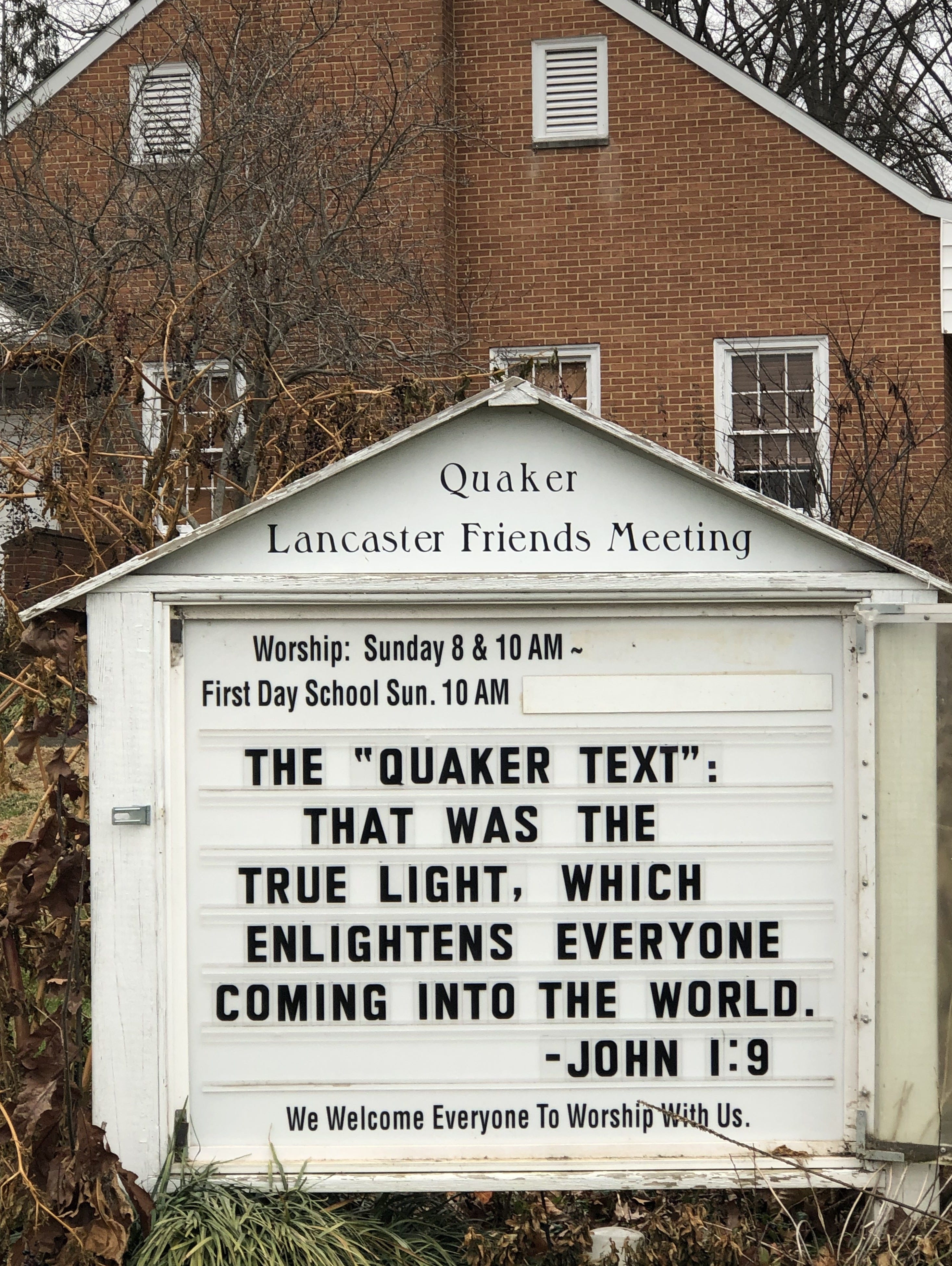
Below is the Advent message on our Meetinghouse signboard (the translation is the New KJV, but I have changed “every man” to “everyone”). This verse was constantly cited by early Friends; I believe it was Robert Barclay who first referred to it as “the Quaker Text.”